🚀 The World in 2050: How Humanity Will Live, Work, and Adapt
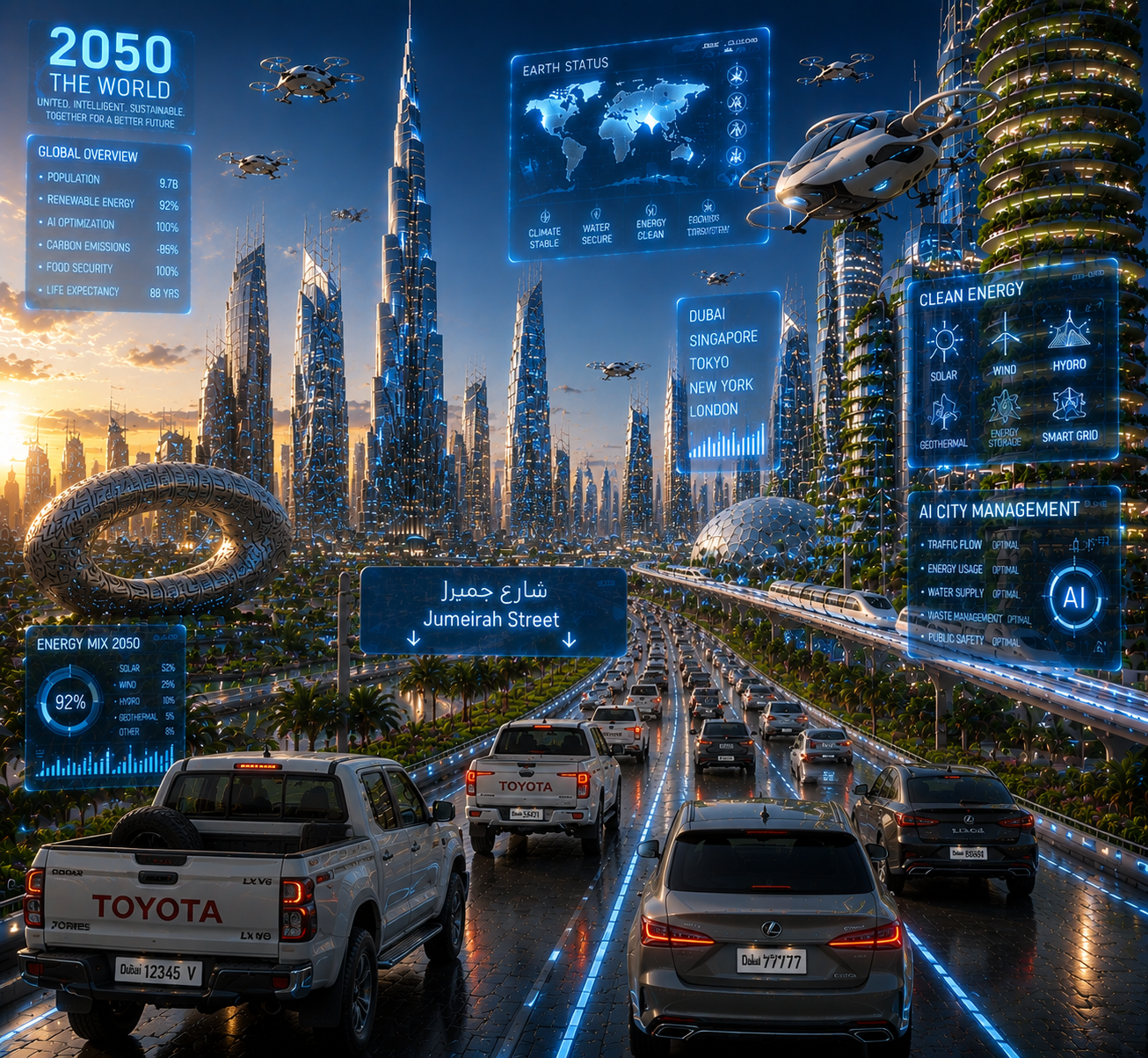
🚀 The World in 2050: How Humanity Will Live, Work, and Adapt 🌅 A Glimpse Into 2050 By 2050, daily life feels seamless, intelligent, and hyper‑connected. Homes regulate themselves, cities run on AI, and climate pressure forces humanity to innovate faster than ever. Countries like the UAE, Japan, Singapore, and the U.S. lead the transformation — building the blueprint for a future defined by technology, sustainability, and human adaptability.
🏙️ Cities of the Future Cities evolve into smart, vertical ecosystems powered entirely by clean energy. 🤖 AI‑Managed Infrastructure AI controls traffic, water, electricity, waste, and emergency response — predicting problems before they happen. 🚗 Autonomous Transportation Self‑driving pods, electric fleets, and AI‑coordinated metros replace traditional cars. ✈️ Flying Taxis Dubai’s flying taxi tests become global reality, creating sky highways and aerial mobility networks. 🏢 Smart Vertical Cities Buildings become intelligent organisms with solar skins, vertical farms, and self‑repairing materials. 🔋 Renewable Energy Supergrids Solar, hydrogen, wind, and geothermal systems power entire cities with zero emissions. 🏛️ Digital Governments Paperwork disappears. Citizens interact with government through digital IDs, voice assistants, and blockchain-secured systems.
🤖 Artificial Intelligence and Human Life AI becomes humanity’s daily collaborator. 🧠 AI Assistants Digital companions manage schedules, finances, health, and home systems. 🩺 AI Doctors Instant diagnosis, predictive healthcare, robotic surgery, and personalized treatment plans. 🎓 AI Teachers Adaptive learning, VR classrooms, and global digital education networks. 🤝 Human‑AI Collaboration Humans focus on creativity and strategy while AI handles data and repetition. ⚠️ Risks Privacy concerns, algorithmic bias, and overdependence require strong regulation.
💼 The Future of Work Work becomes flexible, creative, and deeply integrated with automation. 🤖 Robotics Everywhere Robots dominate manufacturing, logistics, construction, and agriculture. 🧪 New Industries Quantum computing, space mining, climate engineering, virtual world design, and autonomous transport networks. 🧩 Human Skills Creativity, emotional intelligence, critical thinking, adaptability, and leadership become essential. 🌍 Global Digital Nomads VR offices and AI-managed workflows allow people to work from anywhere.
🧬 Healthcare in 2050 Healthcare shifts from treatment to prediction. • AI diagnosis • DNA-based personalized medicine • Gene editing • Wearable health monitoring • Longer life expectancy
🌡️ Climate Change & Environmental Challenges Climate pressure reshapes global priorities. ⚠️ Challenges Rising temperatures, water shortages, extreme weather, food insecurity. 🌱 Solutions Renewable energy, carbon capture, vertical farming, water recycling, and AI-managed resource systems.
🎓 Education & Skills of the Future Education becomes lifelong and AI-powered. • Personalized AI tutors • VR classrooms • Continuous skill upgrades • Learning to adapt, unlearn, and relearn
🚀 Space & New Frontiers Space becomes humanity’s next economic zone. • Space tourism • Moon & Mars bases • Orbital manufacturing • Satellite-powered global systems • Early space mining
🧭 How to Prepare for 2050 👤 Individuals Learn AI skills, stay creative, protect the environment, build financial resilience, and embrace lifelong learning. 🏢 Businesses Automate, innovate, adopt sustainability, and train for future skills. 🏛️ Governments Invest in digital infrastructure, regulate AI, reform education, and protect natural resources.
🌟Conclusion: The Future Is Built Today 2050 isn’t a distant world — it’s the result of choices made now. If humanity embraces innovation, sustainability, and human potential, the future will be not just advanced, but extraordinary.