The Streaming Wars Are Consolidating — What That Means for Your Subscriptions
The Streaming Wars Are Consolidating — What That Means for Your Subscriptions
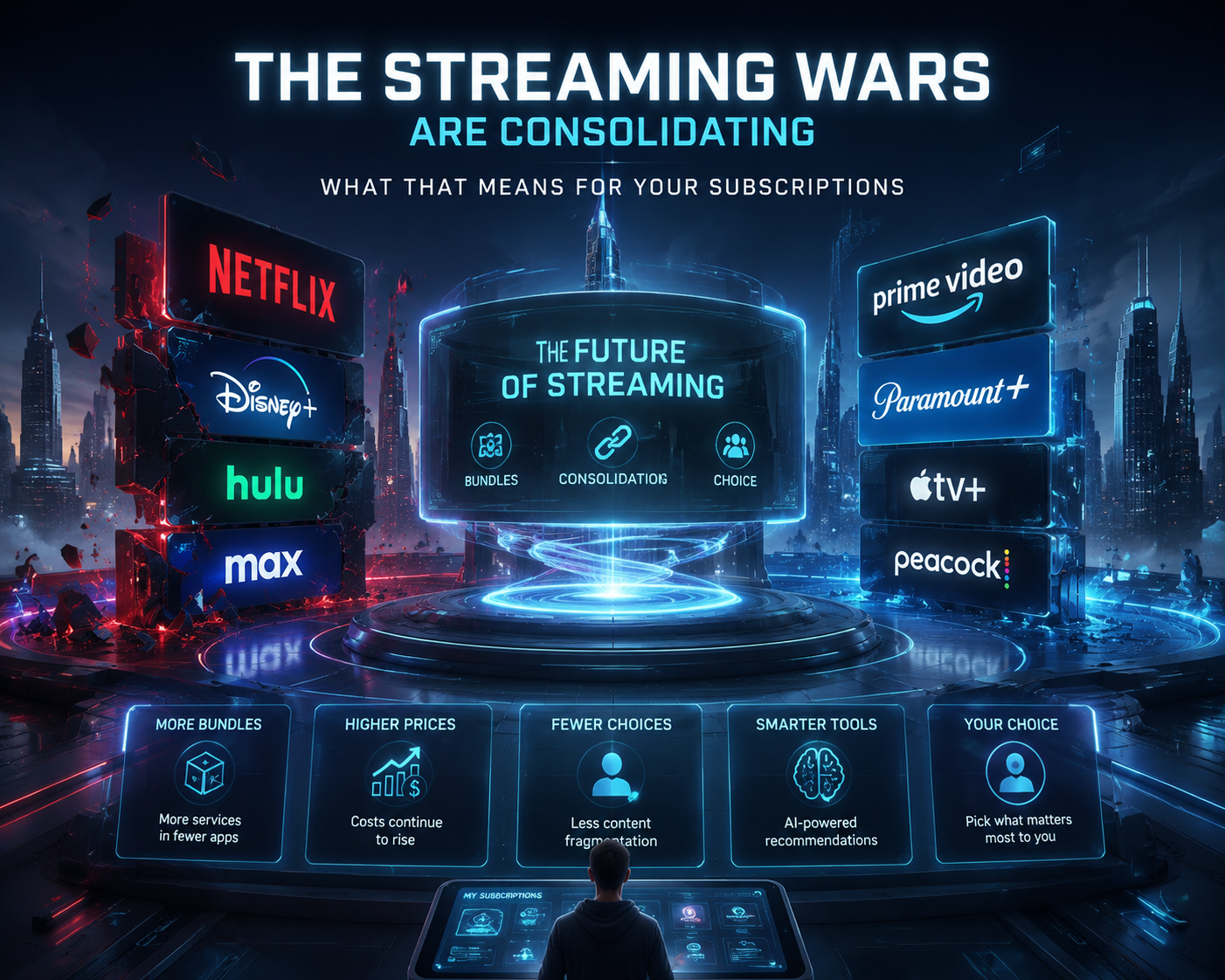
Streaming's first decade had a clear playbook: every studio and network launched its own platform, betting that owning the direct relationship with viewers was worth walking away from licensing deals. That land grab produced a genuinely fragmented market — a dozen different subscriptions just to watch what used to live under one cable bill. That era is winding down, and what's replacing it looks less like more competition and more like consolidation.
Merging Instead of Multiplying
Where the last decade was defined by new platforms launching, the current trend runs the other direction: platform mergers combining catalogues, technology, and subscriber bases rather than each company continuing to run a standalone service. Fewer, larger platforms is the direction the industry is actually moving, even after years of encouraging exactly the opposite behavior from viewers.
The End of Easy Password Sharing
Password-sharing crackdowns are one of the clearest signs platforms have shifted from growth-at-any-cost to squeezing revenue out of the audience they already have. For years, sharing a login across households was quietly tolerated as a growth strategy — more eyeballs, more cultural relevance. Once subscriber growth in mature markets slowed, that tolerance largely disappeared, replaced by enforcement measures aimed at converting shared accounts into paying ones.
Ads Return to "Premium" Streaming
Ad-supported tiers becoming standard, even on services that launched as strictly ad-free premium products, is another piece of the same story. Advertising revenue offers a second income stream beyond subscription fees, and cheaper ad-supported tiers give price-sensitive viewers a reason to stay subscribed rather than cancel entirely. What started as streaming's alternative to cable increasingly includes the exact commercial breaks it was originally built to avoid.
Bundling Comes Back Around
Streaming services are increasingly sold packaged together — several subscriptions bundled into one price, echoing the old cable bundle model streaming was originally supposed to replace. That's a notable full-circle moment: an industry that built its early pitch around "pay only for what you watch" is increasingly steering viewers back toward paying for a bundle of things they may only partially use.
The Economics Behind the Shift
None of this is arbitrary. Content costs are enormous — licensing, production, and marketing at streaming scale is genuinely expensive — and subscriber growth in mature markets has slowed considerably compared to the early boom years. Consolidation and advertising are how platforms reach actual profitability rather than growth-fueled losses, which is exactly why the direction has shifted from "launch more platforms" to "combine, monetize harder, and bundle."
Why It Still Matters
For viewers, the practical effect is a market that increasingly resembles the one streaming set out to disrupt: fewer, larger providers, ads creeping back into the experience, and bundles replacing standalone subscriptions. The specifics will keep shifting, but the underlying direction is consistent — an industry moving from a growth phase built on fragmentation into a maturity phase built on consolidation and monetization.
SEO Keywords: streaming wars, streaming consolidation, password sharing crackdown, ad-supported streaming, streaming bundles, media industry, subscription fatigue