The Rise of On-Device AI: Why Your Phone Is Getting Smarter Without the Cloud
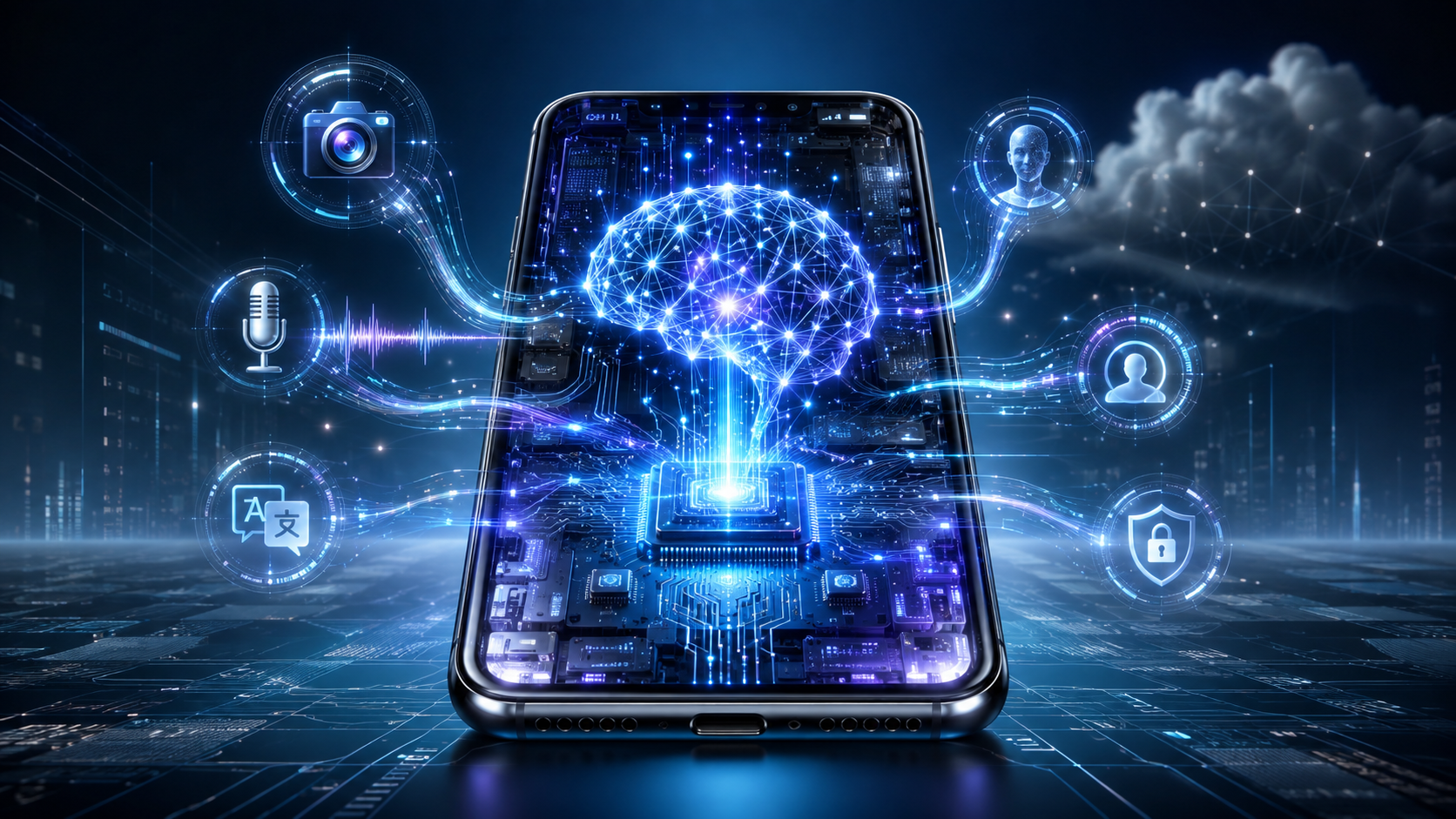
The Rise of On-Device AI: Why Your Phone Is Getting Smarter Without the Cloud
For years, "AI on your phone" really meant "your phone talking to a server somewhere else." You typed a request, it traveled to a data center, a large model processed it, and the answer came back. That round trip is starting to disappear for a growing share of tasks — not because the cloud got worse, but because phones got dramatically better at running intelligence locally.
What On-Device AI Actually Means
On-device AI refers to machine learning models that run directly on a phone's own hardware — its processor and dedicated AI silicon — instead of sending data to a remote server for processing. This isn't new in concept; phones have used small on-device models for things like keyboard autocorrect and basic photo enhancement for years. What's changed is scale: today's flagship phones can run genuinely capable AI models locally, including tasks that used to require cloud compute.
The Hardware That Made It Possible
The real enabler is the Neural Processing Unit, or NPU — a chip component built specifically to accelerate the matrix-multiplication math that machine learning models rely on, far more efficiently than a general-purpose CPU or GPU could manage for the same task. Nearly every modern flagship chipset now ships with a dedicated NPU, and each generation dramatically increases the size and complexity of models that can run smoothly on-device. What required a data center five years ago increasingly fits in a chip the size of a fingernail.
Why Privacy Is the Biggest Selling Point
The most immediate benefit of on-device AI is privacy: when a model runs locally, sensitive data — a photo, a voice recording, a personal message — never has to leave the device to be processed. That matters for anyone who's ever hesitated to ask an AI assistant something personal, and it matters even more for enterprise and healthcare use cases where sending data off-device raises real compliance questions. On-device processing sidesteps that entire category of concern by design, not by policy.
Latency Is the Other Half of the Story
The second major advantage is speed. A cloud round-trip — sending data out, waiting for a server to process it, and receiving a response — takes time, and that time is unpredictable depending on network conditions. On-device processing removes the network entirely from the equation, which matters enormously for real-time tasks like live translation, camera-based augmented reality, or voice commands that feel sluggish the moment there's a half-second of lag.
The Tradeoff: Smaller Models, Real Limits
None of this means the cloud is going away. On-device models are necessarily smaller and less capable than the largest cloud-hosted models, simply because a phone doesn't have the power budget or physical space of a data center. The emerging pattern across the industry is hybrid: simple, fast, privacy-sensitive tasks handled on-device, while more complex reasoning still gets routed to the cloud when it's actually needed. The phone increasingly acts as a smart filter, deciding which requests it can handle itself and which ones genuinely require more horsepower.
Why It Still Matters
On-device AI is quietly becoming one of the most consequential shifts in mobile technology — not because it produces a flashier demo, but because it changes the default assumption about where your data goes and how fast your device can respond. As NPUs keep improving, expect more of what currently requires an internet connection to simply work locally instead, with the cloud reserved for the tasks that genuinely need it.
SEO Keywords: on-device AI, NPU, neural processing unit, AI privacy, edge AI, mobile chips, smartphone AI, latency