The Professor Who Gave His Company to MIT: The Bose Story
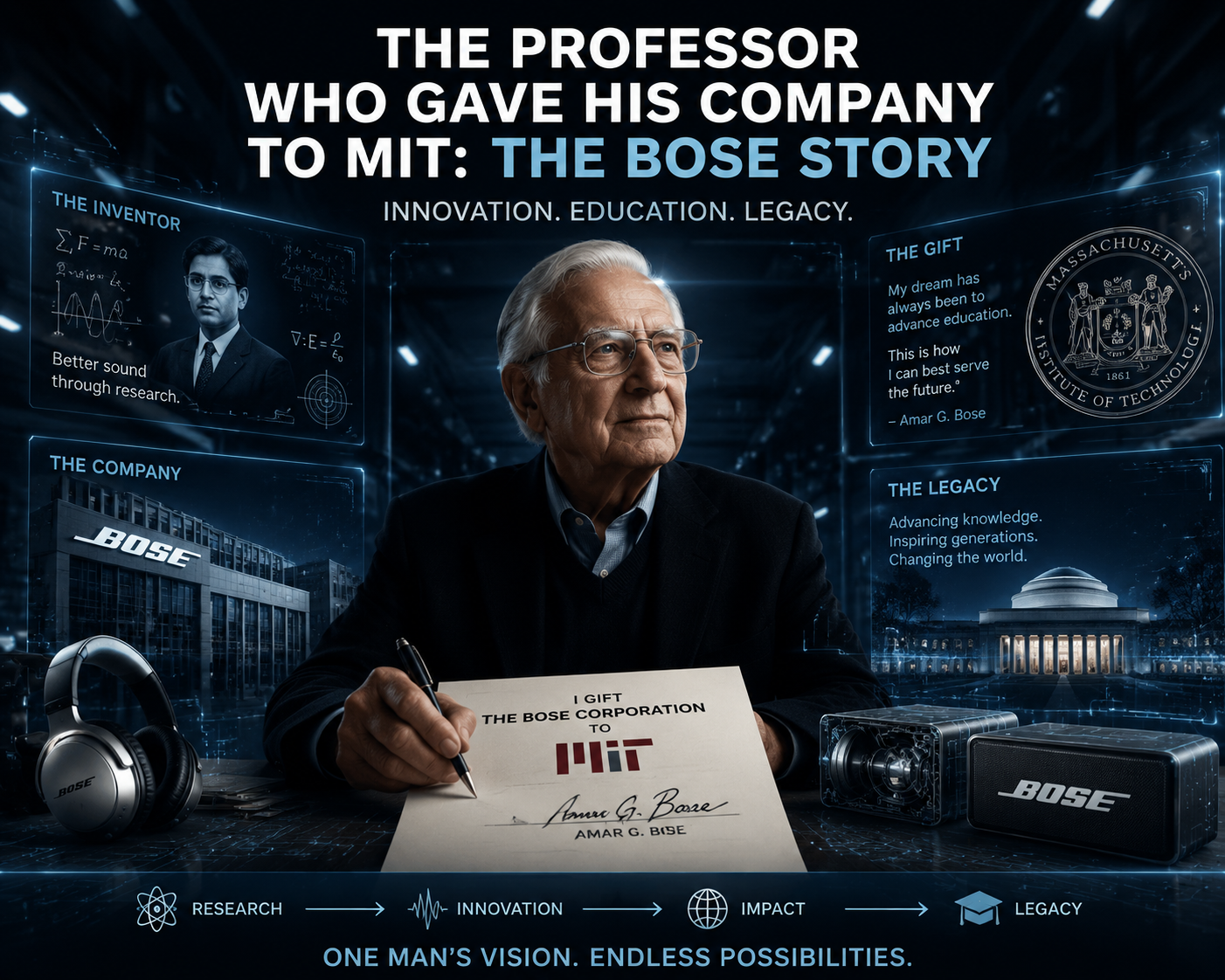
The Professor Who Gave His Company to MIT: The Bose Story
Most audio brands start with someone who loves sound. Bose started with someone who was disappointed by it — and had the engineering background at MIT to actually do something about that disappointment.
A Bad Stereo and a Better Question
Dr. Amar Bose was an MIT electrical engineering professor when he bought a stereo system in the early 1960s that looked great on paper — strong specs across the board — and sounded flat and disappointing in his actual living room. Instead of shrugging it off, he did what an MIT professor does: he started researching why. That research, into psychoacoustics — how humans actually perceive sound, as opposed to what a spec sheet measures — became the founding philosophy of the company he started in 1964. The mission was never "win the numbers game." It was "engineer for how sound is actually heard."
Noise-Cancelling, From the Cockpit to the Commute
That research-first approach shows up clearly in Bose's most famous consumer contribution: active noise-cancelling headphones. The QuietComfort line, which brought consumer ANC headphones into the mainstream, built on noise-cancelling research the company had originally developed for aviation — technology designed to protect pilots' hearing and let them think clearly in loud cockpits, later adapted for a much bigger, much noisier everyday problem: the commute.
An Ownership Structure Almost No Other Company Has
Here's the detail most people don't know, and it's genuinely unusual: in 2011, Dr. Bose donated a majority of the company's shares to MIT, his alma mater and former employer. MIT receives dividends from that stake, but has explicitly no voting rights and no role in how the company is actually run. Bose Corporation has never gone public. It remains privately held and independently operated out of Framingham, Massachusetts to this day — a sharp contrast to JBL, which now sits inside Samsung's Harman division, or Sony, which answers to public shareholders. Bose answers to neither.
Why It Still Matters
That independence shows up in the product philosophy: Bose still tends to prioritize how something actually sounds and feels to use over chasing a spec sheet, which is exactly the instinct the company was founded on. Whether it's a portable speaker for the living room or a pair of noise-cancelling earbuds for the flight to Dubai, the engineering lineage traces straight back to a professor who got annoyed at a bad stereo and had the means to fix the underlying problem instead of just buying a different one.
Browse the current Bose lineup on our Featured Brands page.
SEO Keywords: Bose history, Amar Bose, MIT ownership, Bose Corporation, QuietComfort history, noise-cancelling headphones, psychoacoustics