The Hidden Cost of AI: Why Data Centers Are Becoming a Global Energy Story
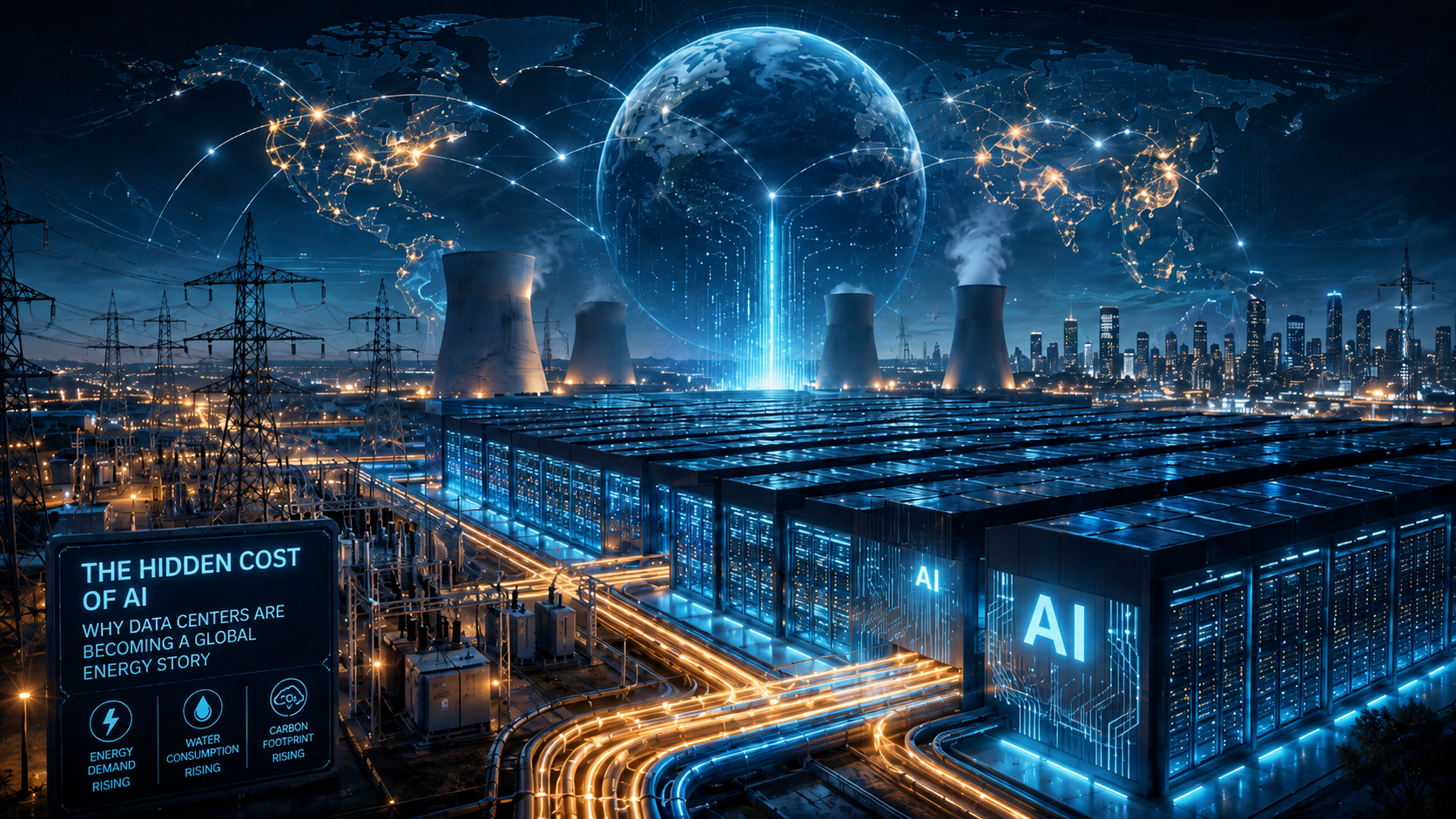
The Hidden Cost of AI: Why Data Centers Are Becoming a Global Energy Story
Every AI response — a chatbot answer, a generated image, a search summary — happens somewhere physical: a server, in a data center, drawing real electricity. As AI use has scaled from a novelty to a daily habit for hundreds of millions of people, that physical infrastructure has quietly become one of the biggest energy stories in the tech industry.
Training vs. Inference: Two Different Energy Costs
AI's energy use splits into two distinct phases. Training a large model — the process of teaching it from massive datasets — is an enormous, one-time (or periodic) compute expense, often running across thousands of specialized chips for weeks at a time. Inference — actually running the trained model to answer a real request — is a smaller cost per use, but it happens constantly, at massive scale, every time anyone uses the product. As AI adoption grows, inference's cumulative energy footprint increasingly rivals or exceeds training's.
Why AI Chips Draw So Much More Power
The specialized chips that make modern AI possible — GPUs and dedicated AI accelerators — are dramatically more power-hungry per unit than the general-purpose chips that ran most of the internet's previous workloads. A single AI-optimized server rack can draw many times the power of an equivalent traditional server rack. That density is exactly what makes them fast at AI math, but it also means data centers built for AI need fundamentally more electrical and cooling capacity than data centers built for ordinary web hosting.
Cooling Is Its Own Resource Problem
Densely packed, high-power chips generate enormous heat, and keeping them within safe operating temperatures is its own significant resource draw — many data centers rely on water-based cooling systems that consume substantial volumes of water, on top of the electricity bill. In water-stressed regions, that's sparked real scrutiny from local communities and regulators, not just an abstract sustainability concern.
An Infrastructure Race, Not Just a Software Race
The companies building the most capable AI models are also, increasingly, in a race to secure power and land for data centers — signing massive long-term energy contracts, in some cases investing directly in new power generation (including renewable and nuclear projects) specifically to guarantee supply for future AI infrastructure. That's a notable shift: the bottleneck on AI progress is no longer purely about who has the best algorithms, but increasingly about who can secure enough electricity to run them at scale.
The Sustainability Tradeoffs Are Real
None of this is a reason to treat AI energy use as uniquely villainous — plenty of existing industries are energy-intensive too — but it is a genuine tradeoff that gets less attention than it deserves. More efficient chips, smarter model architectures that need less compute per task, and a genuine shift toward renewable power sources are all active areas of investment specifically because the current trajectory of AI energy demand isn't something the industry can ignore.
Why It Still Matters
The convenience of typing a question and getting an instant, well-reasoned answer obscures a genuinely large physical infrastructure working behind it. As AI becomes more embedded in daily products, the energy and water story behind it will increasingly shape where data centers get built, how much AI services cost, and how seriously the industry invests in efficiency rather than just raw scale.
SEO Keywords: AI energy consumption, data centers, AI infrastructure, sustainability, AI chips, GPU power, cooling systems, tech infrastructure