The Controller Wars: How DualSense Changed What a Game Controller Could Do
The Controller Wars: How DualSense Changed What a Game Controller Could Do
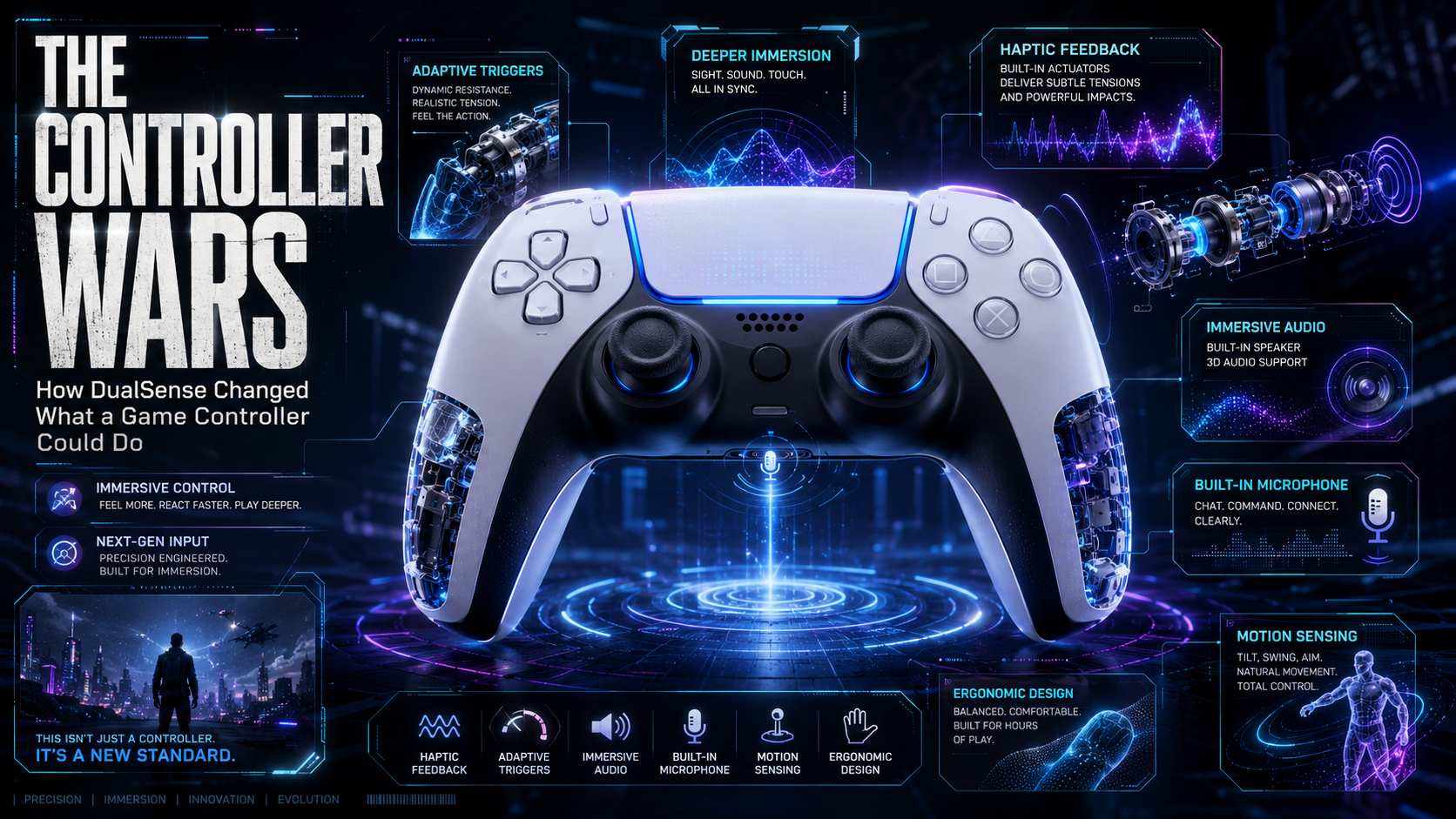
For most of gaming history, a controller's job was simple: register button presses and buzz when something exciting happened. Sony's DualSense, launched alongside the PlayStation 5 in 2020, treated that as a starting point rather than the whole job — and in doing so, reset expectations for what a standard console controller should be able to do.
Beyond Generic Rumble
Previous-generation controllers relied on rumble motors that produced one generic vibration, regardless of what was actually happening on screen — the same buzz for an explosion, a footstep, or a menu notification. DualSense replaced that with haptic feedback: more nuanced vibration capable of simulating distinct textures and sensations rather than a single undifferentiated rumble. Walking on gravel can feel different from walking on metal; a light tap can feel different from a heavy impact. That's a genuinely different category of feedback, not just a stronger version of the old one.
Triggers That Push Back
The more talked-about advance was adaptive triggers on the L2 and R2 buttons — triggers that can dynamically change their resistance depending on what's happening in the game. Drawing a bowstring can feel like an increasing pull; pressing an accelerator under load can feel like genuine mechanical resistance building up. It's a level of physical feedback controllers simply didn't offer before, built directly into standard hardware rather than sold as a specialty add-on.
Small Additions That Added Up
DualSense also built in a microphone directly into the controller, along with a handful of other quality-of-life features aimed at making the controller more self-sufficient — fewer accessories required to get the full experience Sony intended. None of these individually redefined gaming, but together they signaled a controller designed as a more complete piece of hardware rather than the minimum viable input device.
The Edge: Borrowing From the Pro Controller Market
Sony later released the DualSense Edge, a premium controller aimed specifically at competitive and professional players — remappable buttons, adjustable trigger stops, and swappable analog-stick modules. Those are features third-party "pro controller" makers had been offering for years to a dedicated competitive audience. What changed is that the platform holder itself started building them directly, rather than leaving that market entirely to aftermarket accessory brands.
Why It Still Matters
DualSense didn't just add features to one controller generation — it raised the baseline for what a standard console controller is expected to include industry-wide. Once haptic feedback and adaptive triggers existed as a mainstream, bundled-in-the-box standard, "just rumble" started to feel like a step backward rather than a neutral default. That shift in expectations, more than any single feature, is the real legacy of the redesign.
SEO Keywords: DualSense, PlayStation 5 controller, haptic feedback, adaptive triggers, DualSense Edge, gaming controllers, console hardware