Open-Source AI Models Are Catching Up to the Giants — Here's Why That Matters
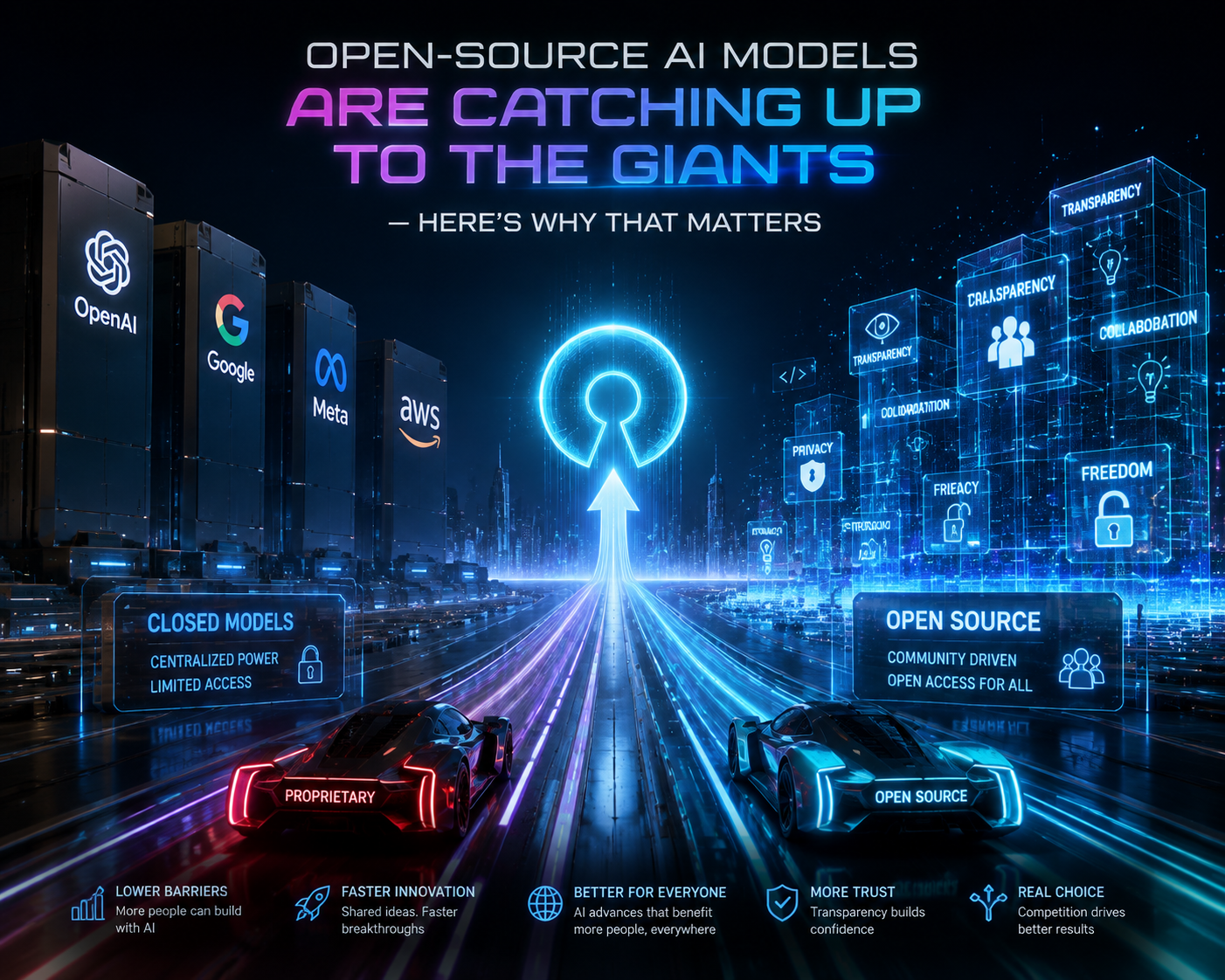
Open-Source AI Models Are Catching Up to the Giants — Here's Why That Matters
For the first few years of the modern AI boom, the most capable models were locked behind APIs owned by a handful of well-funded labs. If you wanted genuinely strong AI, you paid for access to someone else's server. That gap hasn't disappeared, but it's narrowed considerably — open-weight models have gone from a distant second tier to genuinely competitive alternatives, and that shift changes who gets to build with AI at all.
What "Open" Actually Means Here
"Open-source AI" is a slightly loose term in practice. Most of what gets called open in this space is more precisely "open-weight": the trained model's parameters are published for anyone to download and run, even if the training data and exact training process aren't fully disclosed. That's a meaningful distinction from traditional open-source software, but the practical effect is similar — a developer or company can download the model and run it themselves, on their own hardware, without depending on a third party's API.
Why the Gap Has Narrowed
Closing the capability gap between open and closed models has come from a few directions at once: more efficient training techniques that get more capability out of the same compute budget, better and cleaner training data, and a genuinely competitive field of labs and companies releasing open-weight models specifically to compete with the closed frontier. Competition tends to accelerate progress, and having multiple well-resourced organizations releasing open models on a regular cadence has done exactly that.
Running Your Own Model Changes the Economics
The most immediate practical benefit of open-weight models is control over cost and infrastructure. A company processing a huge volume of requests can run an open model on its own hardware (or rented cloud compute) instead of paying a per-request API fee to a closed provider — at sufficient scale, that's a meaningful cost difference. It also means no dependency on a third party's uptime, pricing changes, or usage policies for a core piece of a product's infrastructure.
Data Never Has to Leave the Building
For regulated industries and privacy-sensitive use cases, running an open model entirely on infrastructure you control means sensitive data never has to be sent to an external API at all. That matters for healthcare, legal, financial services, and any government or enterprise context where data residency and confidentiality requirements make sending information to a third-party server complicated or outright prohibited.
The Tradeoffs Are Real Too
None of this makes open models an automatic win. Running a large model yourself requires real infrastructure and technical expertise that a hosted API abstracts away entirely — you're trading a monthly bill for hardware costs, engineering time, and ongoing maintenance. The very largest, most capable closed models still generally hold an edge at the true frontier of difficult reasoning tasks, even as that gap keeps shrinking. The right choice genuinely depends on the specific use case, not a blanket rule that open is always better or cheaper.
Why It Still Matters
The rise of genuinely competitive open-weight models means the ability to build serious AI products is no longer gated entirely behind a handful of API providers. That has real consequences: more experimentation, more competition on price and features, and more options for organizations that need to keep their data in-house. Whichever side of the open-versus-closed debate ends up ahead on raw capability at any given moment, the existence of a real open alternative is what keeps the whole market honest.
SEO Keywords: open-source AI, open-weight models, LLM, AI industry, enterprise AI, AI infrastructure, model deployment