Inside America’s New Space Race
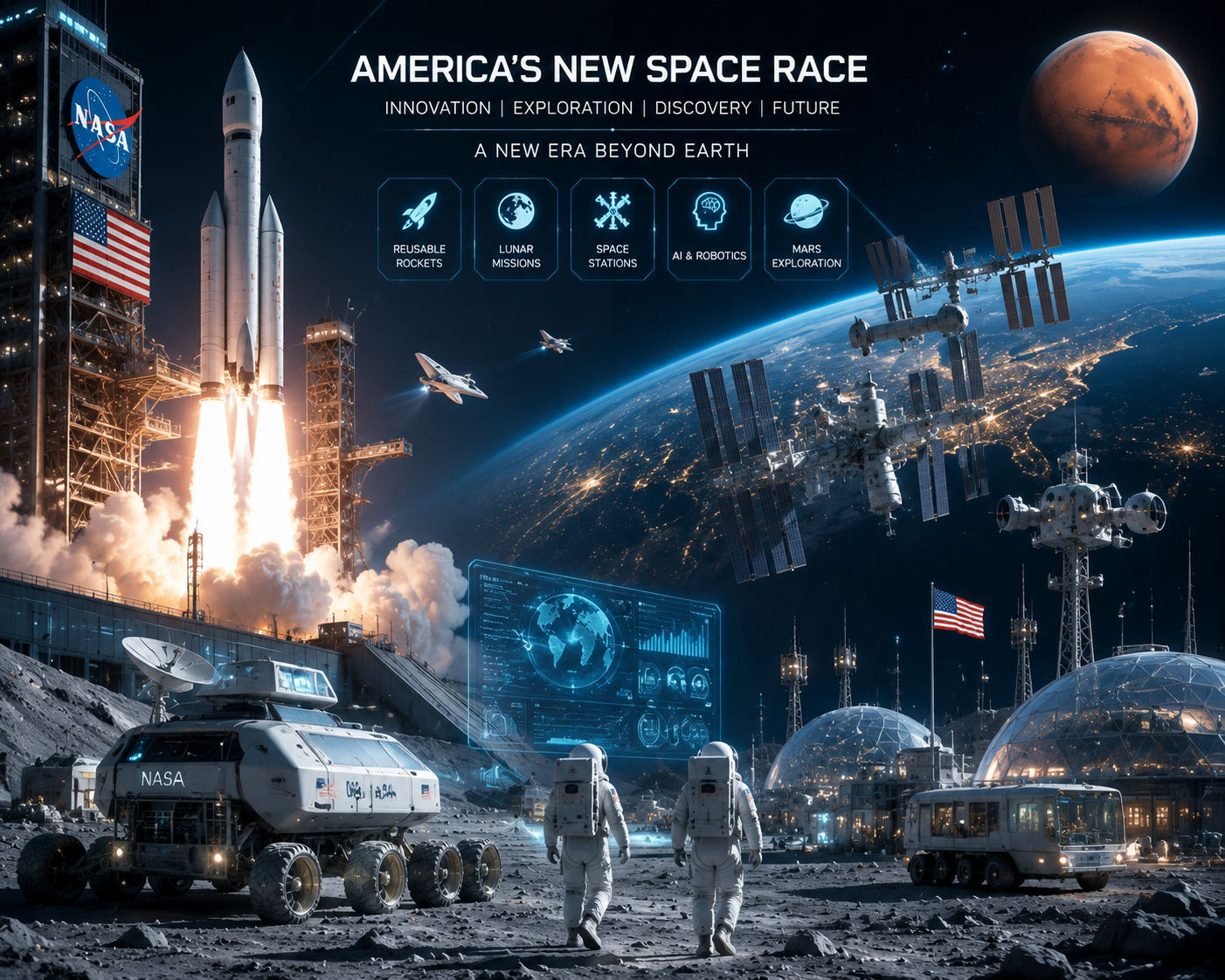
For decades, space represented one of humanity’s greatest challenges. It was a place of discovery, competition, and ambition — a frontier where nations proved their technological capabilities and expanded the limits of what humans could achieve. Today, a new space race is beginning. But this time, it is not only about reaching the Moon first or planting a flag on another planet. It is about building an entire space economy — creating new industries, developing advanced technology, and preparing humanity for a future where space becomes a part of everyday life. America is once again looking beyond Earth. A New Era Beyond the Moon The first space race was defined by competition between governments. The next one is being shaped by collaboration between governments and private companies. NASA continues to lead major exploration programs, while companies such as SpaceX, Blue Origin, and other aerospace innovators are developing reusable rockets, advanced spacecraft, and new technologies designed to make space more accessible. The goal is no longer just exploration. The goal is infrastructure. The future of space may include: Permanent lunar research stations Commercial space travel Advanced satellite networks Space manufacturing Missions to Mars Space is becoming the next major platform for innovation. The Rise of Private Space Companies One of the biggest changes in modern space exploration is the rise of private aerospace companies. For decades, space missions were almost entirely controlled by national agencies. Today, private companies are developing technology that was once considered impossible. Reusable rockets have changed the economics of space travel by reducing launch costs and increasing the frequency of missions. This shift has created a new model: Governments provide vision and research. Private companies provide speed, competition, and innovation. Together, they are accelerating humanity’s journey beyond Earth. The Moon Becomes America’s Next Destination The Moon is becoming a central focus of America’s space strategy. Unlike previous missions, future lunar exploration is designed to create a long-term presence rather than a short visit. The Moon could become a testing ground for: New technologies Space habitats Scientific research Resource exploration A sustainable lunar presence could eventually support deeper missions, including human exploration of Mars. The Moon may become humanity’s first step toward becoming a multi-planet civilization. The Business of Space Is Taking Off Space is no longer only a scientific mission. It is becoming a major economic opportunity. Future space industries could include: Space Tourism Private companies are developing spacecraft that could allow civilians to experience space travel. Satellite Technology Satellites are becoming essential for communication, navigation, weather monitoring, and global connectivity. Space Manufacturing Some materials may be produced more efficiently in microgravity environments. Orbital Infrastructure Future stations could serve as research centers, commercial hubs, and transportation points. The space economy could become one of the most important industries of the coming decades. Artificial Intelligence Will Power the Next Space Era Space exploration is becoming increasingly dependent on artificial intelligence. AI systems can help spacecraft navigate, analyze massive amounts of data, and support astronauts during missions. Future missions may rely on AI for: Autonomous spacecraft operations Planetary exploration Space robotics Mission planning Scientific discovery As missions travel farther from Earth, intelligent systems will become essential partners for human explorers. Preparing Humanity for Mars Mars remains one of the biggest goals in space exploration. Reaching the Red Planet is not only a transportation challenge. It requires solving complex problems: Long-duration space travel Human health in space Food production Radiation protection Sustainable habitats The technology developed for Mars missions could also transform life on Earth. The challenges of space often create solutions for problems here at home. Why the New Space Race Matters The new space race is not just about rockets. It is about innovation, economic growth, and humanity’s future. The technologies created through space exploration have already influenced everyday life, from communication systems to advanced materials and scientific discoveries. The next generation of space technology could create opportunities we cannot yet imagine. The question is no longer whether humanity will expand beyond Earth. The question is how far we will go. The Final Frontier Is Only Beginning America’s new space race represents a new chapter of exploration. It is powered by ambition, technology, and the belief that the next great discoveries are still waiting beyond our planet. The future of space will not be built by one person, one company, or one nation. It will be created by everyone willing to look beyond the horizon. Because humanity’s greatest achievements have always started with one simple idea: There is still more to discover. Visual Brief A cinematic space scene showing America’s next space era: a futuristic NASA-style launch facility, reusable rockets taking off, astronauts walking on the Moon, orbital stations above Earth, AI-controlled spacecraft, and a glowing Mars horizon in the distance. Use deep space blues, metallic silver, and warm golden lighting for a premium technology magazine style.