🇦🇪 How the UAE Became the UAE: The Story of a Union That Changed the Middle East
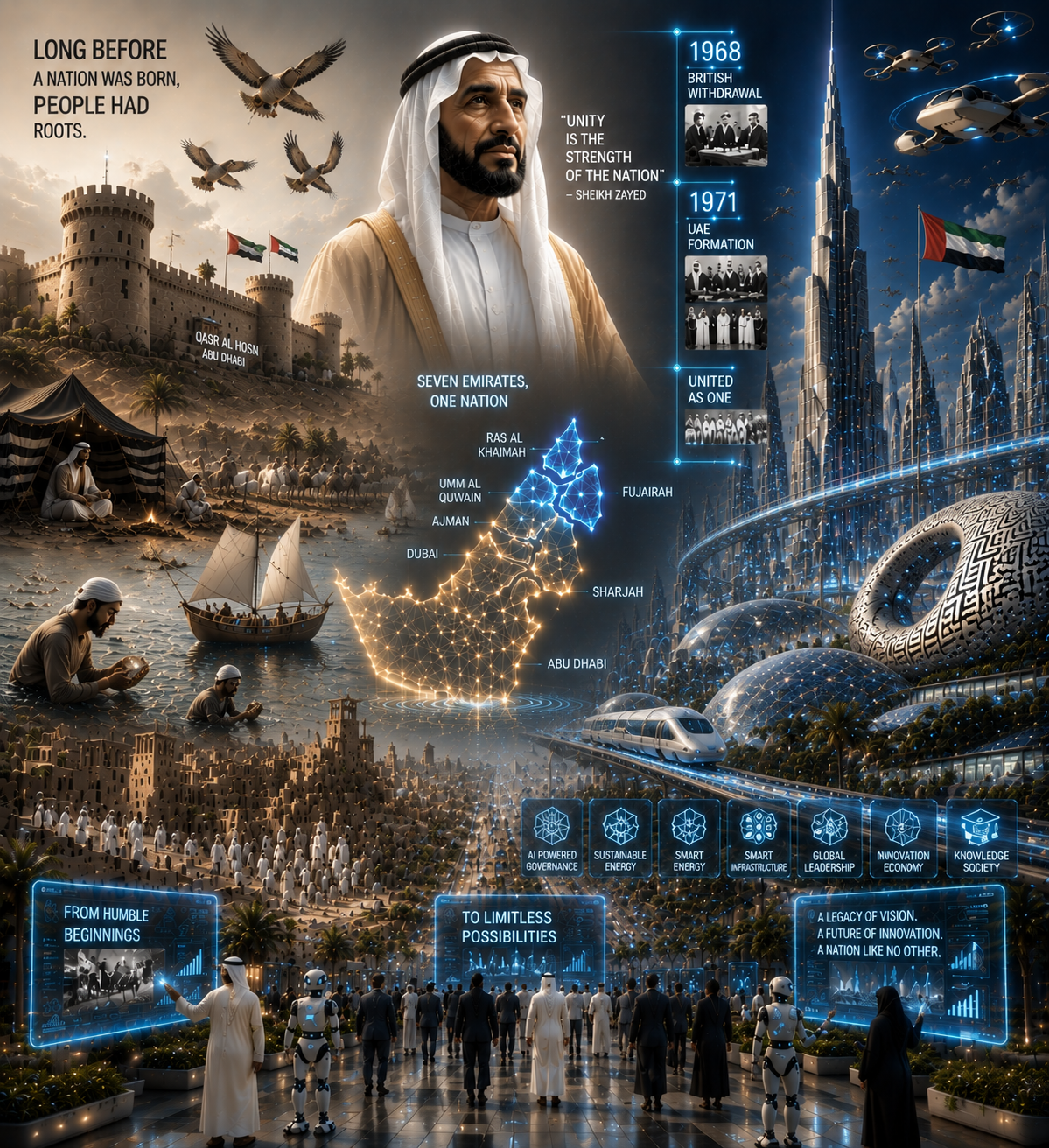
🌍 1. Before the UAE: A Land of Trade, Tribes, and Empires Long before the seven emirates united, the region was shaped by: • Arab tribes and ruling families • Persian cultural influence • Portuguese and Dutch expansion • British naval dominance in the 18th–19th centuries The emirates were known as the Trucial States, a group of independent sheikhdoms under British protection after a series of truces in the 19th century. These sheikhdoms included: • Abu Dhabi • Dubai • Sharjah • Ajman • Umm Al Quwain • Ras Al Khaimah • Fujairah Each ruled by its own dynasty.
🛡️ 2. British Protection & the Trucial States Era In 1892, the Trucial States signed a treaty with Britain: • Britain handled defense • The emirates could not make foreign agreements without British approval • Britain protected the coast from maritime aggression This arrangement lasted until the late 1960s.
🛢️ 3. Oil Discovery Changes Everything Oil was discovered in Abu Dhabi in 1962, followed by Dubai and Sharjah. This transformed the region economically and politically. The emirates suddenly had: • Revenue • Infrastructure • Global interest • Strategic importance But they also needed unity to manage this new era.
🇬🇧 4. Britain Announces Withdrawal (1968) In January 1968, Britain announced it would withdraw from the Gulf by the end of 1971. This created uncertainty — and a potential power vacuum. The emirates needed a plan.
🤝 5. The Historic Abu Dhabi–Dubai Agreement On 18 February 1968, Sheikh Zayed bin Sultan Al Nahyan (Abu Dhabi) and Sheikh Rashid bin Saeed Al Maktoum (Dubai) met in the desert at Argoub Al Sedirah. They agreed on the principle of forming a union. This was the first step toward the UAE. Soon after, the rulers of Sharjah, Ajman, Fujairah, and Umm Al Quwain joined discussions to create a federation. Bahrain and Qatar initially participated but later chose independence.
🏛️ 6. The Birth of the UAE — December 2, 1971 On December 2, 1971, six emirates officially formed the United Arab Emirates: • Abu Dhabi • Dubai • Sharjah • Ajman • Umm Al Quwain • Fujairah Ras Al Khaimah joined shortly after on February 10, 1972, completing the seven-emirate federation. Sheikh Zayed became the first President of the UAE. The UAE immediately gained international recognition and joined the United Nations.
🕌 7. Why the Union Worked The UAE succeeded because of: Visionary Leadership Sheikh Zayed and Sheikh Rashid believed unity was essential for stability, development, and global standing. Shared Culture & History The emirates had common tribal roots, traditions, and economic interests. Strategic Timing Britain’s withdrawal forced the emirates to choose between fragmentation or federation. Economic Opportunity Oil revenue made development possible — but unity made it sustainable.
🚀 8. The UAE After 1971: A Nation Transformed After the union, the UAE rapidly built: • Schools • Hospitals • Roads • Airports • Ports • Modern cities Oil revenue funded development, but leadership ensured long-term stability. By the late 20th century, the UAE had become one of the fastest-growing nations in the world.
⭐ Conclusion: How the UAE Became the UAE The UAE was born from: • Vision • Unity • Leadership • Timing • Shared destiny From ancient trade routes to the Trucial States, from oil discovery to the historic 1971 union — the UAE’s formation is a story of courage and collaboration. Today, the UAE stands as one of the most successful federations in modern history — a nation built on unity, ambition, and a belief in a better future.