AI Agents Are Learning to Use Computers Like Humans Do
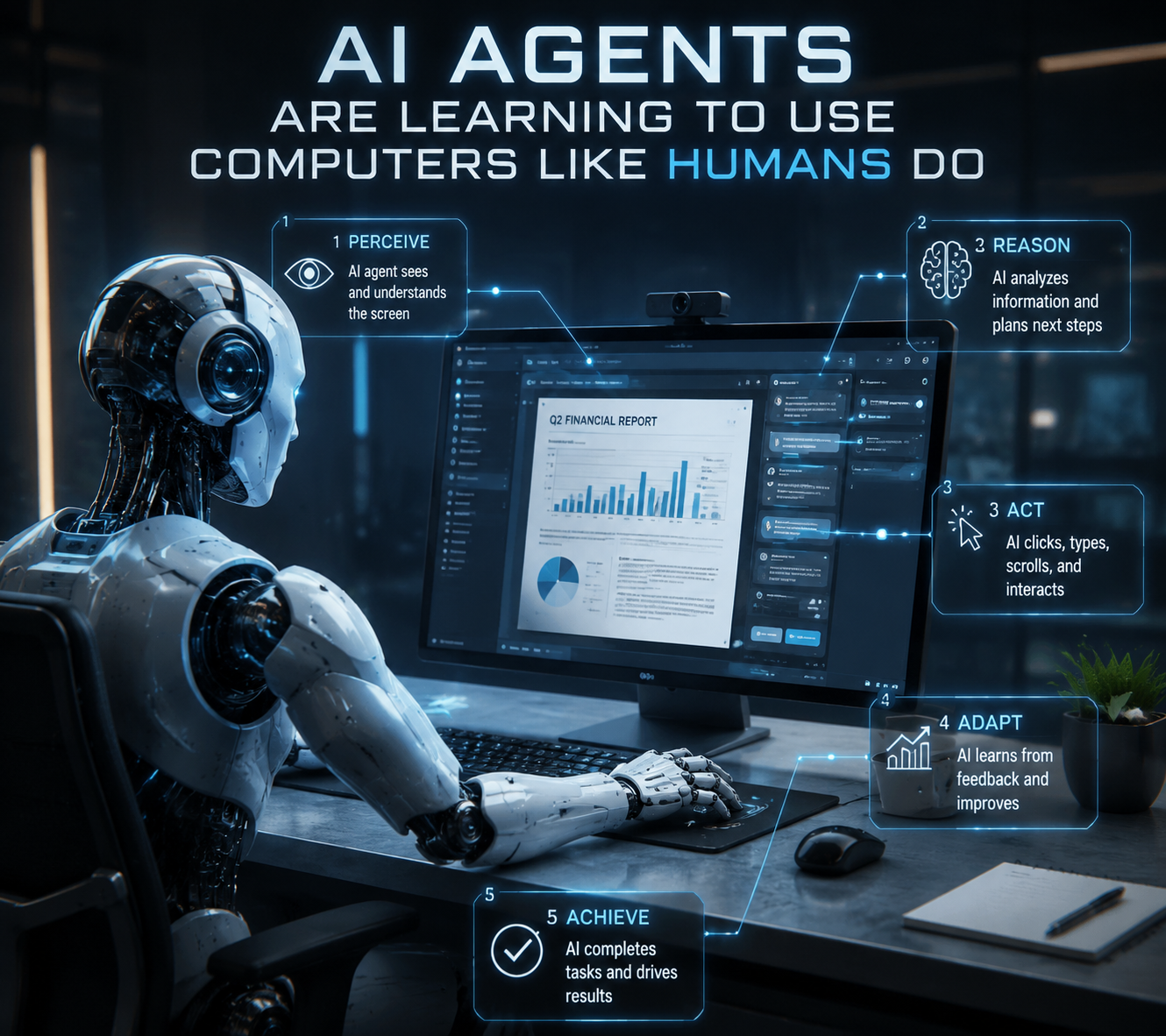
AI Agents Are Learning to Use Computers Like Humans Do
For most of the chatbot era, AI could only answer questions — it couldn't act on them. You'd ask for help writing an email, and then you'd still have to open your email client, paste the text in, and hit send yourself. That gap between "AI gives advice" and "AI does the task" is closing fast, and it's arguably the biggest shift in what these systems are for.
From Answering to Acting
An AI agent, in the current sense of the term, is a system that can take a goal, break it into steps, and actually carry those steps out — clicking buttons, filling in forms, running code, navigating between apps — rather than just describing what a human should do next. The distinction matters enormously in practice: a chatbot that tells you how to reconcile a spreadsheet is a reference tool; an agent that actually opens the spreadsheet and reconciles it is a coworker.
Computer Use: Teaching AI to See a Screen
One of the more striking recent developments is AI models that can operate a computer the same way a person does — by looking at screenshots, identifying buttons and fields, and clicking or typing in response. This is different from older automation approaches that relied on rigid, pre-programmed scripts tied to a specific app's layout. A model working this way can, in principle, use software it's never specifically been trained on, the same way a new employee can figure out an unfamiliar piece of software by looking at the screen.
Why Tool Use Is the Real Unlock
Agents become genuinely useful once they can call external tools — searching the web, running code, querying a database, sending an API request — rather than relying purely on what they already "know." This lets an agent check current information instead of guessing, verify its own work by actually running it, and chain multiple tools together to complete a task that requires more than one step. It's the difference between an assistant that can only talk about a problem and one that can go check the facts and come back with an actual answer.
Multi-Step Tasks Without Constant Supervision
The most ambitious agent systems can now handle tasks that span many steps without a human approving each one individually — planning an approach, executing it, checking whether it worked, and adjusting course if it didn't. This kind of extended autonomy is still an active area of development, and it raises real questions about how much oversight is appropriate for a given task. A low-stakes research task and a task that touches real money or production systems don't call for the same level of hands-off trust.
The Trust Problem Nobody's Fully Solved
Letting software take real-world actions on your behalf — sending messages, making purchases, editing files — means the cost of a mistake is no longer just a wrong answer in a chat window. The industry's current answer is a mix of permission systems (asking before doing anything irreversible), sandboxing (letting an agent experiment somewhere consequence-free before touching anything real), and human-in-the-loop checkpoints for higher-stakes actions. None of these are perfect solutions yet, but they're the scaffolding that's making increasingly autonomous agents usable in practice rather than purely experimental.
Why It Still Matters
The shift from chatbot to agent is a shift in what "using AI" even means day to day — less a search box you type questions into, more a capable assistant that can actually get things done while you focus on something else. The technology is still maturing, and the right amount of autonomy to hand over depends heavily on the task, but the trajectory is clear: AI is increasingly judged not by how well it can explain something, but by whether it can actually go do it.
SEO Keywords: AI agents, agentic AI, computer use AI, autonomous AI, tool use, AI automation, multi-step AI tasks